

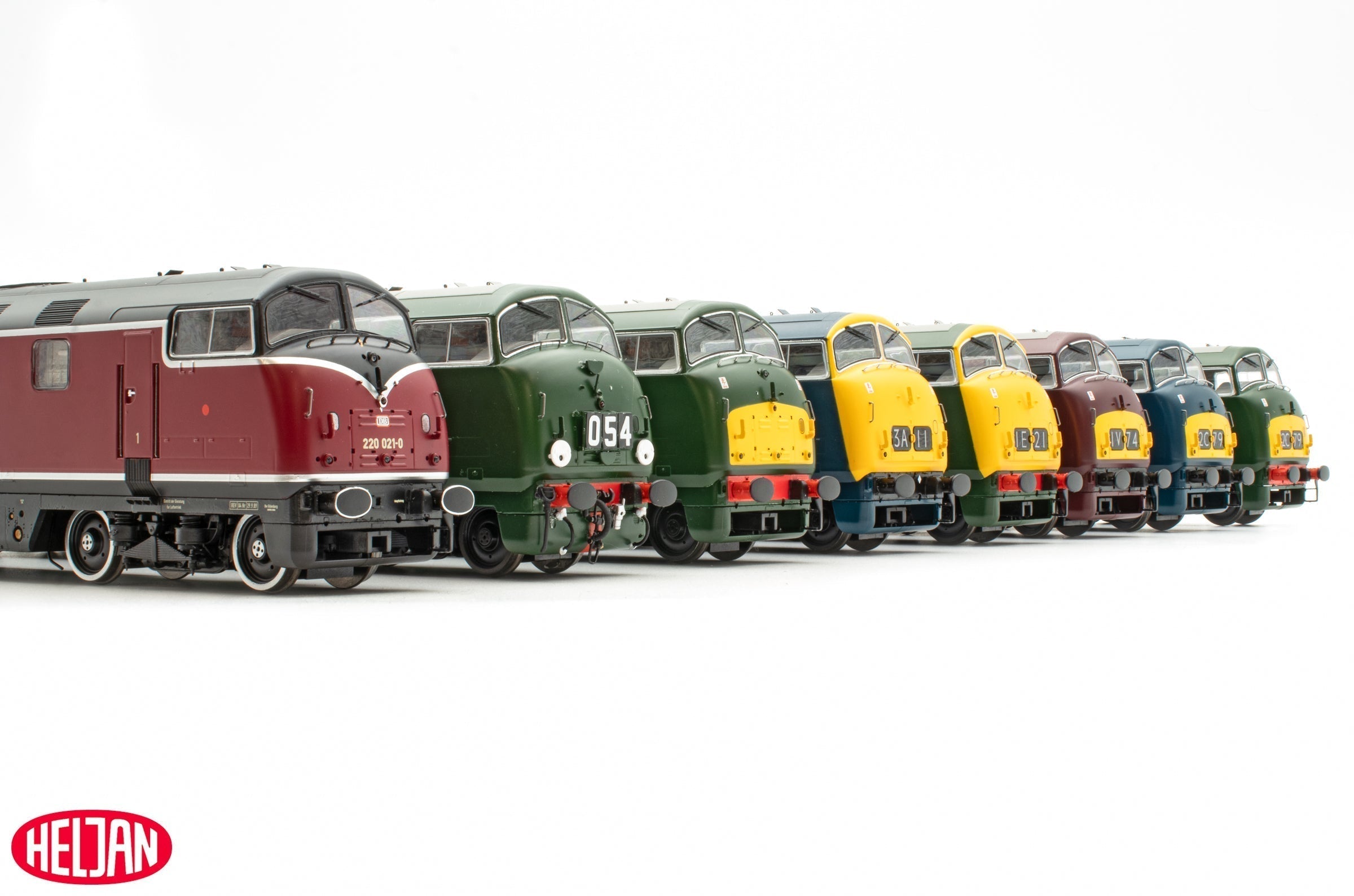
Western Region diesel-hydraulic enthusiasts will soon be able to expand their fleets with an unprecedented range of high-specification Heljan ‘OO’ gauge Class 42 ‘Warships’.
Production is now complete and models are expected to arrive in around three months - just in time for the new modelling season.

For the first time in more than 40 years, a brand-new model of the Swindon-built ‘Warship’ is coming to market, combining classic liveries, new versions and a level of detail never before seen on this iconic class.
Our brand new 'Warships' are available to order now at www.heljan.com, with a full range of liveries covering the entire BR career of these pioneering locomotives - plus a special preservation-era livery.

Designed to reflect the many variations found across the 38-strong class, the range includes both early locomotives with headcode discs and later examples with roller blinds and glazed headcode panels. Extensive tooling variations allow accurate representation of key prototype differences throughout the class’s working life.
Following more than three years of research and development, the models have also benefited from customer feedback, with refinements including enhanced decoration and reducing the size of the silver window frames and adding the rubber grommets to give a more prototypical appearance.

Performance matches appearance, with a large 5-pole motor, flywheels and smooth, quiet running. All models feature a factory-fitted speaker, 21-pin DCC interface, independently controlled lighting and provision for premium ESU sound, recorded from D821 Greyhound at the Severn Valley Railway.

What's more - you can pick up a 'Warship' from just £149.99 (DC/DCC Ready) and £249.98 for our DCC Sound-fitted models.
That's £50 less than the former RRP, and another case of Heljan's approach of delivering high quality models at the great value prices that you can afford.

Due to arrive in Q3 2026, you can pre-order your 'Warship' today directly from Heljan - with no deposit down!
Order yours and receive free UK delivery, and Heljan Loyalty Reward Points, that you can exchange for discounts on future orders too - it's the perfect excuse to dive in and buy your favourite model now!
With production locked-in, there's only a limited number available, so be quick to pre-order yours while stocks last!
PRE-ORDER YOUR WARSHIP TODAY
Let's meet the new fleet incoming...
D800 Sir Brian Robertson – BR Green

The first Class 42 ‘Warship’, D800 entered service from Plymouth Laira in 1958 and became a pioneer of the Western Region’s diesel-hydraulic fleet, regularly hauling prestigious expresses including the Cornish Riviera Limited. One of only two locomotives not named after a Royal Navy vessel, it honoured Sir Brian Robertson, Chairman of the British Transport Commission. Built as a prototype with several unique features, D800 was withdrawn in October 1968 after completing more than 923,000 miles.
D802 Formidable – BR Green

One of the three prototype ‘Warships’, D802 entered service at Plymouth Laira in December 1958 and remained there throughout its career. Named after the Royal Navy aircraft carrier HMS Formidable, it was unique among the prototypes in carrying BR green, maroon and BR blue liveries during its lifetime. Rebuilt with standard nose ends in 1964, it was withdrawn in October 1968 and later scrapped at Swindon.
D804 Avenger – BR Green (Small Yellow Panels)

Named after HMS Avenger, the Royal Navy escort carrier lost in 1942, D804 entered service in 1959 and spent much of its career based at Plymouth Laira. It hauled a wide range of Western Region services, including the first accelerated Up Bristolian and later the Liverpool–Plymouth ‘North and West’ route. Rebuilt with standard nose ends and carrying green with small yellow panels for much of the 1960s, it was withdrawn in 1971.
D808 Centaur – BR Green (Full Yellow Ends)

Accepted into service in July 1959, D808 was named after HMS Centaur, a Royal Navy aircraft carrier commissioned in 1953. Originally part of the first production batch of Class 42s, it was rebuilt with standard nose ends in 1964. This model depicts the locomotive in the unusual combination of BR green with full yellow ends, a condition carried by only two Class 42s. D808 served from Laira and Newton Abbot before withdrawal in 1971.
D812 Royal Naval Reserve 1859-1959 – BR Green (Small Yellow Panels)

Delivered to Plymouth Laira in November 1959, D812 was the last Class 42 built with headcode discs and train reporting number frames. Named to mark the centenary of the Royal Naval Reserve, its distinctive two-line nameplates made it one of the most recognisable ‘Warships’. Rebuilt with standard nose ends in 1964, it served at both Laira and Newton Abbot before withdrawal in January 1972, carrying green, maroon and blue liveries during its career.
D826 Jupiter – BR Green (Small Yellow Panels)

D826 entered service at Plymouth Laira in September 1960 and spent its entire career based at either Laira or Newton Abbot. Named after HMS Jupiter, a Royal Navy destroyer lost in 1942, it worked Western Region expresses and later became one of 15 Class 42s equipped with White Diamond multiple-working equipment for Paddington–Plymouth and Penzance services. This model depicts the locomotive in BR green with small yellow panels, carried throughout much of the 1960s.
D831 Monarch – BR Blue (Small Yellow Panels)

Accepted into service in January 1961, D831 spent its entire career based at either Plymouth Laira or Newton Abbot. Named after HMS Monarch, a First World War-era battleship, it became one of only two Class 42s to carry an early non-standard version of BR blue with small yellow panels and serif numbering. This distinctive condition was carried between 1966 and 1969 before the locomotive received full yellow ends and standard numbering.
D832 Onslaught – BR Maroon (Small Yellow Panels)

D832 entered traffic in February 1961 and worked primarily from Plymouth Laira and Newton Abbot throughout its career. Named after the Royal Navy destroyer HMS Onslaught, it carried BR maroon with small yellow warning panels during the late 1960s. Following withdrawal in 1972, D832 avoided scrapping through a spell in BR’s research fleet and became one of only two Class 42 ‘Warships’ to survive into preservation.
D868 Zephyr – BR Blue (Full Yellow Ends/Twin Arrows)

One of the final five Class 42s constructed, D868 entered service in May 1961 and spent most of its career at Plymouth Laira. Named after the Royal Navy destroyer HMS Zephyr, it is depicted in late-1960s BR blue with full yellow ends, twin arrows and period numbering. D868 completed just over one million miles before withdrawal in October 1971, highlighting the intensive work undertaken by the Western Region’s diesel-hydraulic fleet.
V200 021 Windhund – DB Red/Grey

One of the most memorable preservation-era repaints, D821 Greyhound was turned out in mock Deutsche Bundesbahn colours between 1988 and 1990 to celebrate the Class 42’s German V200 ancestry. Operating on the North Yorkshire Moors Railway at the time, it carried temporary Windhund nameplates and briefly the name Doppelgänger. A pioneer of diesel preservation, D821 was among the first BR diesels to be privately purchased and remains active today.
PRE-ORDER YOUR WARSHIP TODAY


